

Introduction
Choosing the right construction material is one of the most important decisions in any building project. Among the most commonly used wall materials in India, AAC blocks and red bricks stand out as the top choices. Each has its own advantages, limitations, and ideal applications.
In this blog, we provide a detailed comparison of AAC blocks vs red bricks, helping homeowners, builders, and contractors make an informed decision based on cost, strength, durability, and long-term benefits.
What Are AAC Blocks?
AAC (Autoclaved Aerated Concrete) blocks are lightweight, precast building materials made from cement, fly ash, lime, sand, and aluminum powder. These blocks are cured under high pressure and temperature, creating a porous structure.
Key Features of AAC Blocks:
-
Lightweight and easy to handle
-
Excellent thermal insulation
-
Fire-resistant
-
Eco-friendly and sustainable
-
High dimensional accuracy
AAC blocks are increasingly popular in modern residential and commercial construction.
What Are Red Bricks?
Red bricks are traditional building materials made from natural clay and fired in kilns. They have been used in construction for centuries across India.
Key Features of Red Bricks:
-
High compressive strength
-
Widely available
-
Cost-effective per unit
-
Familiar to local labor
-
Good durability
Despite newer alternatives, red bricks continue to be widely used.
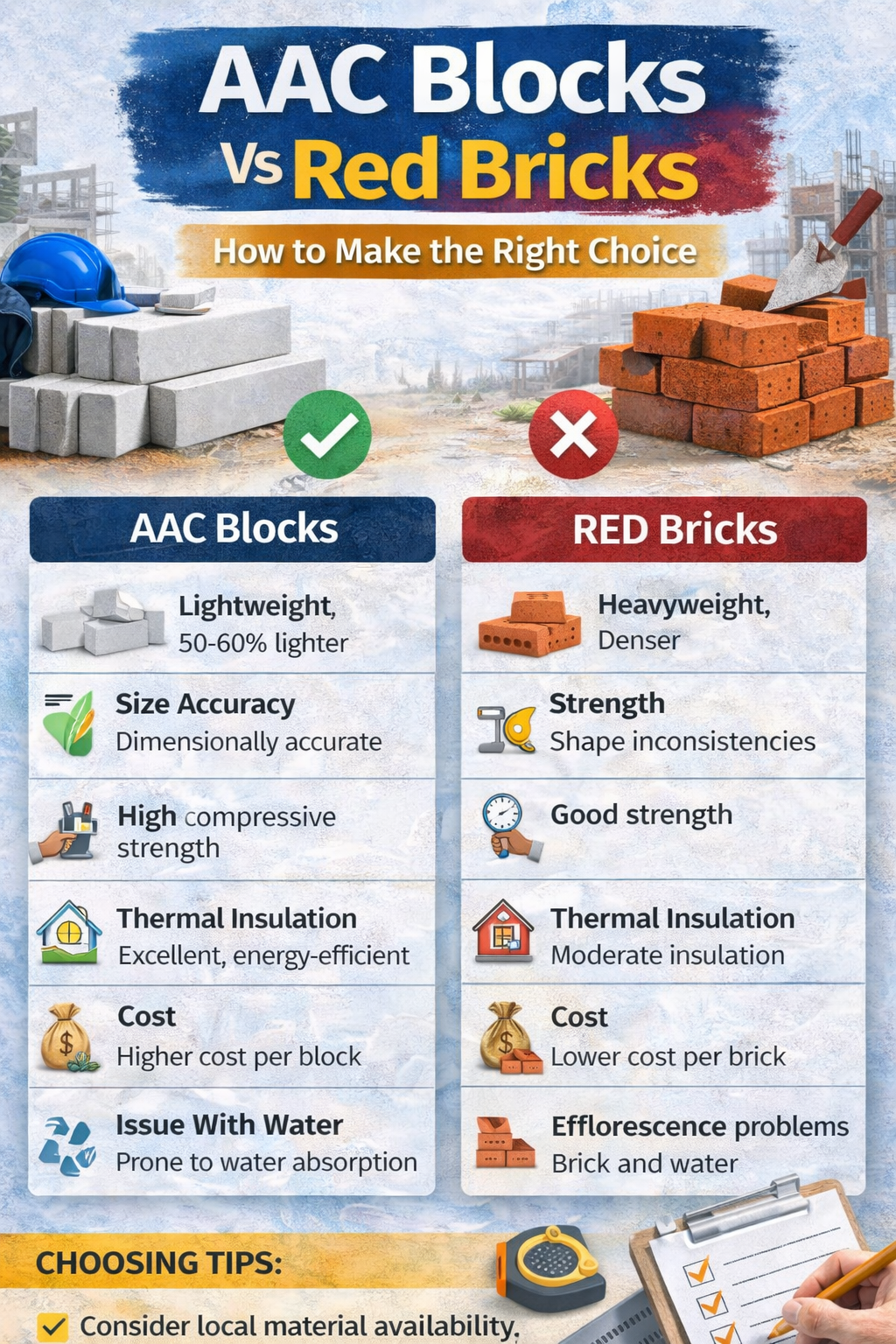
AAC Blocks Vs Red Bricks: Detailed Comparison
1. Weight and Structural Load
-
AAC Blocks:
AAC blocks are nearly 50–60% lighter than red bricks. This significantly reduces the dead load on the structure, making them ideal for multi-storey buildings. -
Red Bricks:
Red bricks are heavier, increasing the load on beams, columns, and foundation.
Winner: AAC Blocks
2. Strength and Durability
-
AAC Blocks:
AAC blocks offer sufficient compressive strength for residential buildings but are slightly weaker than red bricks. -
Red Bricks:
Red bricks provide high compressive strength and are suitable for load-bearing walls.
Winner: Red Bricks
3. Thermal Insulation
-
AAC Blocks:
AAC blocks provide excellent thermal insulation due to their porous structure. Homes stay cooler in summer and warmer in winter, reducing electricity bills. -
Red Bricks:
Red bricks offer moderate insulation but absorb heat more easily.
Winner: AAC Blocks
4. Sound Insulation
-
AAC Blocks:
Provide good sound insulation, especially useful in urban and high-traffic areas. -
Red Bricks:
Offer limited soundproofing compared to AAC blocks.
Winner: AAC Blocks
5. Cost Comparison
-
AAC Blocks:
The cost per block is higher, but savings are achieved through:-
Less mortar usage
-
Faster construction
-
Lower plaster thickness
-
Reduced steel requirement
-
-
Red Bricks:
Lower initial material cost but higher long-term construction and maintenance costs.
Winner: Depends on project budget and planning
6. Construction Speed
-
AAC Blocks:
Larger block size and uniform shape result in faster construction and better finishing. -
Red Bricks:
Smaller size means more joints, more mortar, and slower construction.
Winner: AAC Blocks
7. Water Absorption
-
AAC Blocks:
AAC blocks are more prone to water absorption and require proper waterproofing. -
Red Bricks:
Red bricks are more resistant to water when properly cured.
Winner: Red Bricks
8. Plastering and Finishing
-
AAC Blocks:
Smooth surface requires less plaster thickness, saving cost and time. -
Red Bricks:
Uneven surfaces require thicker plaster.
Winner: AAC Blocks
9. Eco-Friendliness
-
AAC Blocks:
Made using fly ash (industrial waste), AAC blocks are highly eco-friendly and reduce carbon footprint. -
Red Bricks:
Clay extraction and kiln firing cause environmental damage and pollution.
Winner: AAC Blocks
10. Availability and Skilled Labor
-
AAC Blocks:
Availability depends on location. Requires trained labor for best results. -
Red Bricks:
Easily available across India and familiar to most masons.
Winner: Red Bricks
Which Is Better for Home Construction?
Choose AAC Blocks If:
-
You want energy-efficient homes
-
You are constructing multi-storey buildings
-
Faster construction is required
-
You want eco-friendly materials
-
You aim to reduce long-term costs
Choose Red Bricks If:
-
You prefer traditional construction
-
Skilled AAC labor is not available
-
Water exposure is high
-
Initial budget is limited
AAC Blocks Vs Red Bricks: Quick Comparison Table
| Feature | AAC Blocks | Red Bricks |
|---|---|---|
| Weight | Lightweight | Heavy |
| Strength | Moderate | High |
| Thermal Insulation | Excellent | Moderate |
| Cost | Higher per unit | Lower per unit |
| Construction Speed | Fast | Slow |
| Eco-Friendly | Yes | No |
| Plaster Thickness | Less | More |
Final Verdict
There is no one-size-fits-all answer when choosing between AAC blocks and red bricks. The right choice depends on:
Project type
Budget
Location
Availability of materials and labor
Long-term performance expectations
For modern residential construction, AAC blocks are the preferred choice due to their energy efficiency, speed, and sustainability. However, red bricks remain reliable and cost-effective for traditional construction projects.
Consulting an experienced contractor or structural engineer is always recommended before making the final decision.
Contact us today for a free consultation or site evaluation
Tags: ConstructionEngineering


